

What is the future of B2B software applications in the post-AI era?
- Will B2B software evolve as it did during the transition from on-premise to cloud, or will it disappear, displaced by LLMs and other foundational models that integrate up the tech stack?
- Will a new set of native AI startups dominate, as happened in the Cloud era? Or will the incumbents better defend themselves this time around?
- If the former, will the highly funded first movers win? Or will a currently unknown set of followers take their place?
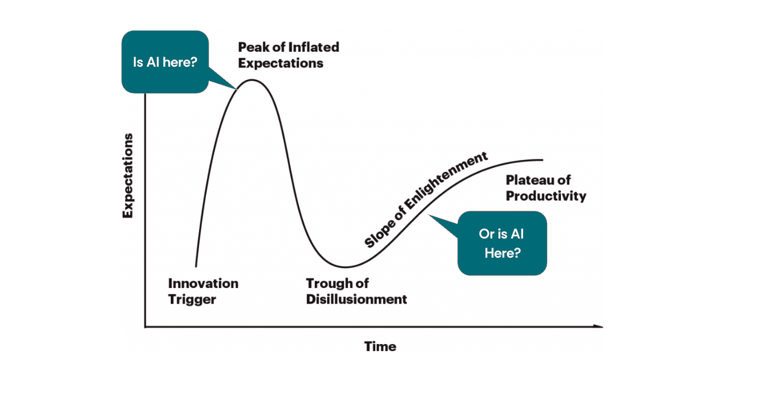
The current phase of AI, as evaluated by the Gartner Hype Cycle, is a useful first step in the analysis. Are we in the “Inflated Expectations” phase or the “Slope of Enlightenment” phase?
There are strong arguments on both sides.

Strongest evidence that AI is in the “Slope of Enlightenment” phase
1. Many studies illustrate that productivity gains are real
Engineering teams are coding ~55% faster, doctors are spending ~40% less time on documentation, customer support teams have decreased average call-handling time by 35%, drug development teams have accelerated competitive-intelligence insights by 30%, and insurance teams have reduced claim-processing and underwriting time by 40% each. Impressive advancements in such a short amount of time.
2. AI-native companies are growing faster than any other startups in history
Anthropic reported annualized revenue increasing 3× in five months. Cursor hit ~$500M ARR within three years of founding, and Lovable reached ~$100M ARR eight months after launch.
3. The “data + workflow + distribution moat” will reward the first movers, unlike past tech disruptions
Better data, tighter workflow embedding, stronger distribution loops, and faster iteration from real-world usage allow first movers to skip the hype cycle and win in the long term.
Strongest evidence that AI is in the “Inflated Expectations” phase
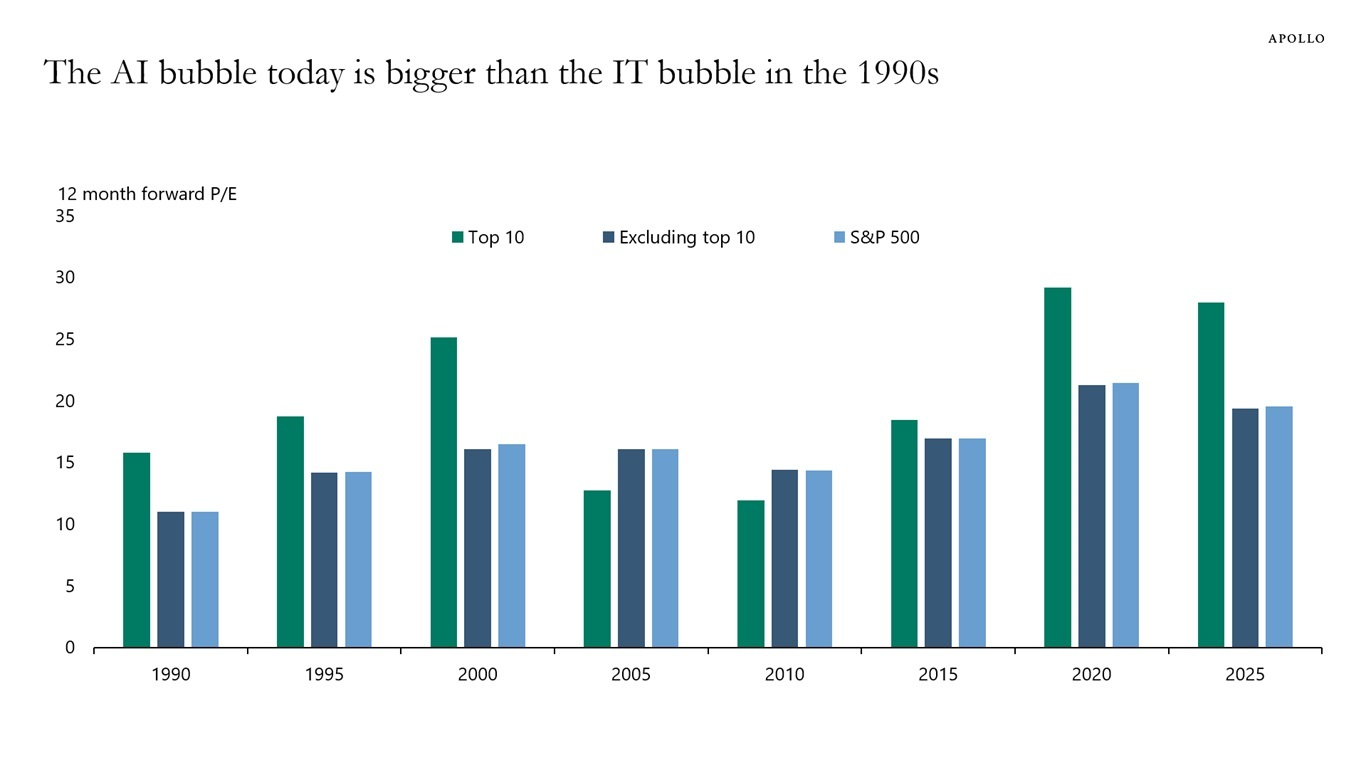
1. Macro investors cite quantitative evidence of a market correction
When the price-to-earnings ratios of the top 10 companies separate significantly from the rest of the S&P, it’s often a signal that market gains are being driven by a very narrow group of stocks. Historically, a market correction follows shortly thereafter.
 2. Some startups are valued above $1B with minimal product deployments or revenue
- TechCrunch reported Thinking Machines Lab raising a $2B seed at a $12B valuation.
- The Financial Times reported Safe Superintelligence being valued around $30B despite being pre‑product.
- Reuters has reported Figure AI financing at valuations on the order of ~$39B.
Of course, these companies are led by experienced founding teams with excellent track records, which largely drive the valuations. While serial successful founders often attract a premium valuation, these figures are at an exponentially new level.
3. Studies suggest the current AI products are not production-ready
Data, skills, and scaling barriers stand in the way of AI success, most AI projects stall at the pilot stage, and those projects that deploy to production fail to meet ROI expectations.
4. The supposed new growth paradigm is not generated by AI as claimed
The headlines state:
- “10× engineers”
- “AEs close $1M per month, not per year”
- “Finance closes the books in hours, not weeks”
- “A new operational paradigm is underway”
However, looking under the hood finds:
- 9-9-6 work weeks
- 5X+ burn ratios
- Decade-old product-led growth, prosumer growth models with high-churn customer bases
- Circular revenue redundancy, where suppliers fund customers who then buy the supplier’s services, creating the appearance of demand amplification, making demand look “cleaner” than it is.
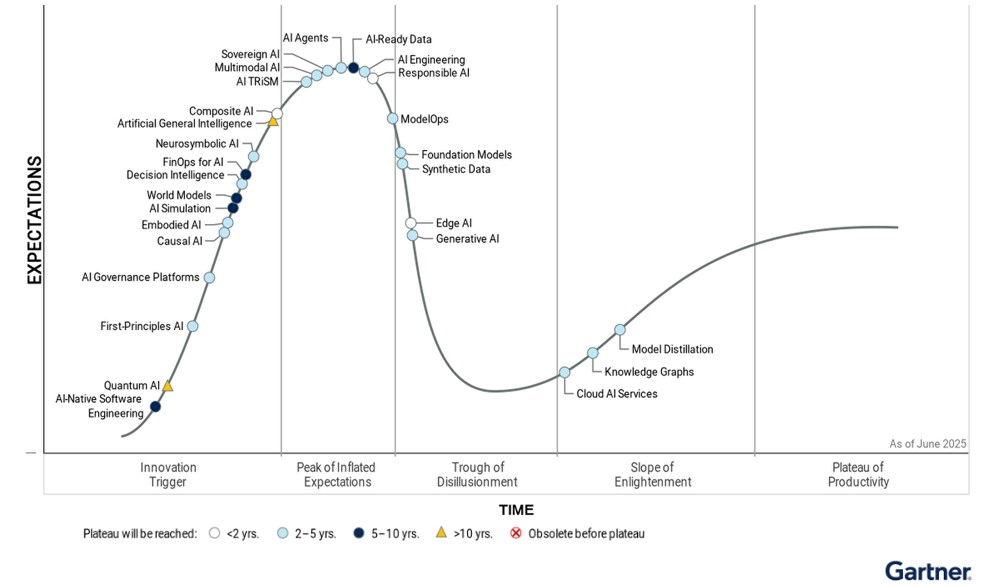
Various AI segments are at different phases of the Gartner Hype Cycle
The Application Layer appears particularly vulnerable. Industry analysts note that AI isn’t a single market. It’s a stack. And “bubble risk,” moat potential, and incumbent staying-power vary dramatically by layer, yielding different positions on the hype cycle.
Many of these segments face the traditional challenge of competing against well-established incumbents. However, the application layer presents two additional challenges:
-
Foundational models are moving up in the stack to the application layer, such as offering general agents for task completion and more specialized tools for coding. Expect much more in the year ahead.
-
CIOs are choosing a “build” over a “buy” strategy for their internal systems. These executives fostered a “bring your own device” and “bring your own app” culture over the last decade. This created SaaS sprawl, resulting in a disparate system of applications and data that is difficult to gain insights from. Because the “AI-our-organization” mandate has been delegated to the Office of the CIO, the Office is learning from past mistakes and prefers to run as much as possible on foundational models and to aggregate data into a centralized data lake. The hyperscalers are aligned and helping their customers with this transition.
Vertical AI opportunities mitigate some of these risks
Vertical AI may be shielded from foundational model disruption
The smaller nature of vertical AI total addressable markets (TAMs), in this case, provides a potential advantage toward building a sustainable business. Historically, the most successful vertical software businesses have achieved market valuations in the billions, and sometimes in the low tens of billions. However, vertical software is less attractive to foundational models than horizontal or functional software, with exponentially higher TAM opportunities. Furthering the case are the more nuanced product requirements seen in vertical software required to meet specific regulatory compliance requirements. Why pursue a smaller TAM with more complex, less transferable product requirements?
Vertical AI may be less exposed to valuation inflation and, in turn, a potential AI bubble
The same trend applies to venture investors. In recent years, most of the venture capital has been deployed by the top 20 firms, many of which are managing multi-billion-dollar funds for the first time. While a 10% ownership stake in a $5 billion exit can generate a 5x return for a $100 million fund, it doesn't significantly affect the returns for multi-billion-dollar funds. These larger funds need to concentrate on major horizontal or functional investments, which leads to heightened competition and inflated valuations for a limited number of deals.
Vertical AI may be shielded from some of the “build” CIO tendencies
CIOs at tech companies may possess the talent and tech stack required to support a "build" mentality. In contrast, CIOs in sectors such as financial services, manufacturing, and healthcare often prefer vendors equipped to meet their industry-specific requirements, including compliance and regulatory standards.
Fast followers may provide a long-term conviction opportunity against the first-mover consensus
Many companies receive sizeable valuation multiples today due to first-mover advantage. The thinking is as follows:
- Raise the biggest round first
- Deter investor interest in the next wave of followers
- Attract the best engineers
- Build the best product
- Define the category and dominate the PR narrative
- Win customers by being the company most likely to own the category
This is logical thinking. However, many studies do not show that first movers win more often than fast followers. Anecdotally, reflecting on the early Internet era:
- Google wasn’t the first search engine.
- The iPhone wasn’t the first mobile phone.
- Salesforce wasn’t the first Cloud CRM.
- Zoom wasn’t the first video conference platform.
- Workday wasn’t the first cloud Human Capital Management system
It's challenging to find a first mover that successfully secured long-term market dominance. First movers face several disadvantages compared to early followers.
- First movers bear substantial demand‑creation and learning costs, the cost of which are not offset by earlier entry.[1]
- Fast followers study the first mover’s actions and outperform by copying the strategies that work and avoiding the ones that do not.[2] This effect is especially true when the tech is new,[3] user needs evolve rapidly,[4] and learning curves are high.[5]
- The high valuation multiples awarded to the first movers are associated with lower long‑run success odds, because they embed unrealistic expectations and induce harmful scaling behavior.[6]
If these dynamics apply to the AI era, the names that dominated the press and fundraising scene over the last two years will likely end up more like Pets.com, Webvan, and AOL, and not Google, Amazon, and Meta.[7]
Key Takeaways
It’s early, so who knows. However, combining observations around today’s context and historical behavior in past, similar situations yields the following:
- The current AI-native B2B software startups face significant risk from foundational model expansion, circular revenue redundancy, high valuation overhang, and first-mover (dis)advantage.
- A potential bright spot in the cohort may be vertical AI startups, where lower TAMs and higher regulatory compliance product requirements shield them from foundational model disruption, valuation overhang, and CIO “build” tendencies.
- In the long term, early followers starting in the “trough of disillusionment” phase may take their respective categories at the expense of the first movers.
Footnotes
1. Boulding, W. and Christen, M. (2008), “Disentangling Pioneering Cost Advantages and Disadvantages,” Marketing Science
2. Ozalp, H., Cennamo, C., and Gawer, A. (working paper, 2022), “First mover, Fast Second or Later Mover in Platform Industries and: Berger, J. et al. (2019), “Don’t be first! An empirical test of the first-mover disadvantage using a TV game show,” Journal of Behavioral and Experimental Economics.
3. Suarez, F. et al. (2022), “Early bird or early worm? First-mover (dis)advantages and the timing of entry in innovation contexts,” Technological Forecasting and Social Change.
4. Hartmann, P. et al. (2016), “Evolving user needs and late-mover advantage,” Industrial and Organizational Psychology / related work as indexed in PubMed Central
5. Chen, J., Chen, J. S., and Posen, H. (2023), “Uncertain Learning Curves: Implications for First-Mover Advantage and Knowledge Spillovers,” Academy of Management Review
6. Neosfera. (2025). Why your $10M valuation is actually a trap: How overvaluation quietly kills startups [Blog post]. Neosfera Insights.
7. Lieberman, M. (2007), “Did First-Mover Advantage Survive the Dot-Com Crash?” analyzing 46 Internet markets and 200+ public dot‑com firms.