

Product–market fit is one of the most overused phrases in startups. It’s also one of the most poorly defined.
Founders invoke it to justify fundraising. Investors use it as a reason (not) to invest. Boards cite it when debating when to scale. Hiring plans, pricing decisions, and go‑to‑market investments often hinge on the answer to a deceptively simple question: Do we have product–market fit?
Yet too often, the answer rests on intuition, anecdotes, or revenue growth alone.
At Stage 2 Capital, we believe product–market fit must be defined with rigor. Not because founders should grow more slowly, but because the healthiest, most durable growth depends on it.
This article starts from first principles. We’ll cover:
- What product–market fit actually means
- Why it matters more than early revenue growth
- How teams achieve it in practice
- How to measure it before it shows up in churn or ARR
This perspective reflects the first stage of The Science of Scaling framework and is foundational to everything that comes next. This methodology was developed by one of our Managing Partners, Mark Roberge and is covered in-depth in his new book, also called The Science of Scaling.
A Clear Definition: Customer Success, Consistently
Most founders can quote Marc Andreessen’s famous definition of product–market fit: “Being in a good market with a product that can satisfy that market.”
Words like good and satisfy leave far too much room for interpretation, especially when founders are under pressure to move quickly. One team’s “satisfied customers” might be another team’s polite early adopters.
At Stage 2, we define product–market fit much more concretely: Product–market fit means consistently generating customer success.
Not once. Not in a handful of lighthouse accounts. And not just for customers acquired through heroic founder effort.
Consistency is the key. If customers predictably succeed with your product, you have product–market fit. If they don’t, you don’t, regardless of how impressive top‑line growth looks in the short term.
Why Product–Market Fit Matters More Than Early Revenue
Most early‑stage companies fail for the same underlying reason: they scale revenue before they scale customer success.
The temptation is understandable. Revenue is visible. It’s praised by investors. It shows momentum. And it unlocks the next round.
But premature scaling carries hidden costs.
When customer success is inconsistent, growth masks structural problems:
- Sales sells to the wrong customers
- Expectations are set incorrectly
- Onboarding fails under volume
- Support becomes reactive
- Churn rises months later, after the hiring and spend are already locked in
The outcome is painfully common: aggressive hiring, missed targets, rapid churn, and a long, expensive reset.
Product–market fit is what prevents this.
It tells you when to scale. It provides a north star that aligns product, marketing, sales, and customer success around value creation, not bookings. And it creates the foundation for repeatable, durable growth.
This is not an argument for slower growth. It’s an argument for healthier growth.
Achieving Product–Market Fit: Do Things That Don’t Scale
Reaching product–market fit is not about efficiency. It’s about learning.
At this stage, the company’s job is to answer one question as quickly and accurately as possible: Who succeeds with our product and why?
That requires deliberate choices across the go‑to‑market motion.
1. Start with Early Adopters
Early adopters are not simply smaller customers or friendlier logos. They are people who:
- Actively seek new solutions
- Tolerate rough edges
- Engage deeply and give feedback
- Care more about progress than polish
They allow for faster learning loops. Larger, more operationally complex customers may carry brand value, but they slow learning and obscure signals. Early product–market fit is about insight, not optics.
2. Redefine What “Winning” Means
At this stage, a signed contract is not a win.
The win is customer success.
Founders should explicitly define success in operational terms and orient the entire go‑to‑market effort around achieving it, even if that means slowing sales cycles or turning away revenue that creates future churn. If this sounds hard, it’s because it is! Turning away revenue requires discipline and long-term thinking.
3. Obsess Over Onboarding
Founders often assume churn is a product issue or a customer success issue. In reality, many retention problems begin in marketing and sales.
Who you target and what you promise dictate whether customers can succeed.
Onboarding should be hands‑on, bespoke, and sometimes uncomfortable in its intensity. If something breaks, that's a signal. If customers struggle, that’s insight. This is learning, not failure.
Measuring Product–Market Fit: Retention, Reimagined
If product–market fit means consistent customer success, how do we measure it?
The most reliable statistical indicator is customer retention. Customers vote with their wallets. Renewals and repeat usage are hard to fake.
But retention alone is not enough.
The Problem with Retention as a Metric
Retention is a lagging indicator. By the time churn data is clear, months—or quarters—have passed. Early‑stage companies rarely have that luxury.
To move faster, teams need a leading indicator of retention.
Defining a Customer Success Leading Indicator
The strongest teams define product–market fit using a simple, testable structure: Product–market fit is achieved when P% of customers complete E event(s) within T days.
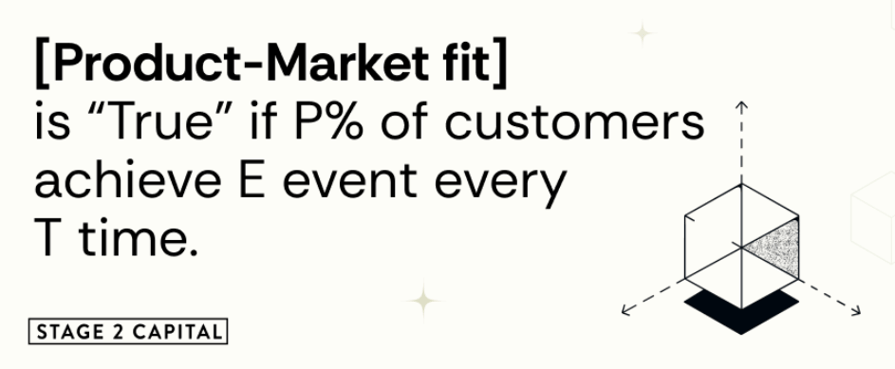
Where:
- P = the percentage of customers who must succeed
- E = a concrete event that represents real customer value
- T = a time window short enough to support learning
Critically, the event must be:
- Objective (it happened or it didn’t)
- Instrumentable (you can measure it reliably)
- Closely tied to value creation
- Aligned with the product’s unique differentiation
Examples from successful companies include early usage milestones, setup completion, or value‑creating actions, not vanity metrics or sales outcomes.
Why This Works
If the leading indicator truly correlates with long‑term retention, it becomes a predictive signal of product–market fit weeks or months earlier than churn data.
That allows teams to:
- Compare customer cohorts
- See improvement (or regression) over time
- Make product and GTM adjustments with confidence
The goal is not perfection. The goal is speed and clarity.
Cohorts: Make Product–Market Fit Visible
Once a leading indicator is defined, teams should track it by acquisition cohort, daily, weekly, or monthly, depending on the business.
Cohort analysis answers questions revenue cannot:
- Are newer customers succeeding faster than earlier ones?
- Are changes to product or onboarding improving outcomes?
- Is customer success becoming more consistent?
For Stage 2 founders, this cohort view should be central. In fact, we believe it belongs ahead of revenue in board discussions at this stage.
If newer cohorts are healthier than older ones, the company is learning. If they aren’t, growth is compounding risk.
Product–Market Fit Is a Gate, Not a Gradient
One of the most dangerous misconceptions is treating product–market fit as a feeling or a spectrum.
In practice, it functions as a gate.
Until customer success is consistent and measurable, adding sales capacity, increasing spend, or expanding markets amplifies variability, not results.
Product–market fit does not guarantee success. But without it, scale reliably guarantees failure.
This is why it sits at the foundation of the Science of Scaling framework. Only after product–market fit is achieved does it make sense to test whether that success can be delivered scalably.
Product–market fit, properly defined and measured, is what keeps velocity aligned with truth.
Get this right, and everything that follows—go‑to‑market fit, growth, and defensibility—has a chance to work.
Get it wrong, and no amount of revenue growth will save the business.
The Science of Scaling: Using Data to Decide When—and How Fast—to Scale Revenue is available on Amazon. 100% of the proceeds will be donated to McLean Hospital to support mental health care and research.