

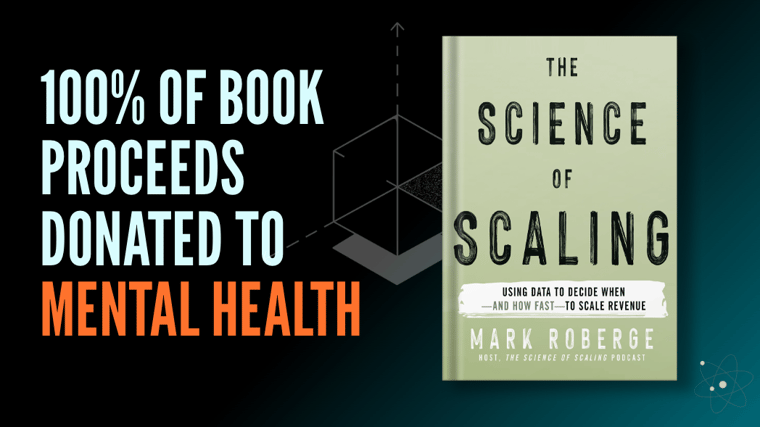
This wasn't a marketing decision; it's a continuation of a cause I've supported for over a decade, and a starting point for a new narrative, though I'm unsure where it will lead.
1. We've Made Progress on Mental Health—But Not Nearly Enough
Over the past few decades, we've made meaningful strides in how we talk about mental health. Compared to my parents' and grandparents' generation—where mental health was often dismissed as either imaginary or a sign of weakness—we're moving in the right direction.
But we're not there yet.
Consider this: if you interview a candidate and learn they survived terminal cancer ten years ago, many people—consciously or not—elevate their perception of the candidate. It signals resilience, grit, and perspective.
Now flip the scenario. If you learn that same candidate struggled with mental illness, the reaction is often different. Instead of admiration, it can introduce hesitation or concern.
That discrepancy is the stigma—and it still persists. Those who suffer must do so in confidence, being careful about whom they share their struggles with and seek support from.
I've seen mental health from multiple angles: as a friend supporting others, as a primary caregiver, and, providing me the most perspective, as a patient. There was a period in my life when I was completely debilitated by mental health challenges. I couldn't work. I couldn't write. I could barely leave my house.
Fortunately, over my career, I've been blessed with achievements valued by general society. Over the past decade, I've applied those gifts and the platform to help normalize the reality that someone can struggle deeply and still go on to lead, build, and contribute at a high level.
I'm sure some people considering a partnership with me saw these remarks and hesitated. However, if sharing that helps chip away at the stigma—even a little—it's worth it.
2. We're Over-Investing in Building AI—and Under-Investing in Understanding the Societal Impact
The second reason is more systemic.
We're living through one of the most significant technological shifts in history. However, orders of magnitude more capital, talent, and general resources are going into building AI than into understanding its societal implications.
As a tech community, we need to do better.
We've seen this movie before. The internet was, on balance, a net positive for society. But it also brought unintended consequences—many of which we're still grappling with today, particularly around mental health.
AI has the potential for even greater societal upside. But it also carries the risk of deeper and more complex costs.
If we only focus on building—and not on preparing—we're repeating the same mistake at a much larger scale.
This donation is a starting point for me around this narrative. I'm not sure what the next step is, but I am sure it will present itself at the right time. In the meantime, I do believe we need to invest more—not just in innovation, but in understanding, mitigation, and support systems for the humans living alongside that innovation.
A Call to Do More
This isn't about having the perfect plan. It's about taking a step.
Whether it's supporting mental health initiatives, contributing to research on AI's societal effects, or simply being more open in our own conversations—we all have a role to play.
The goal isn't just to build the future. It's to make sure we're ready for it.
Want to go deeper on building and scaling with intention?
Mark's book, The Science of Scaling, is a data-driven guide to sustainable revenue growth—built from decades of experience scaling HubSpot and investing in the next generation of B2B companies. It's available now on Amazon.