

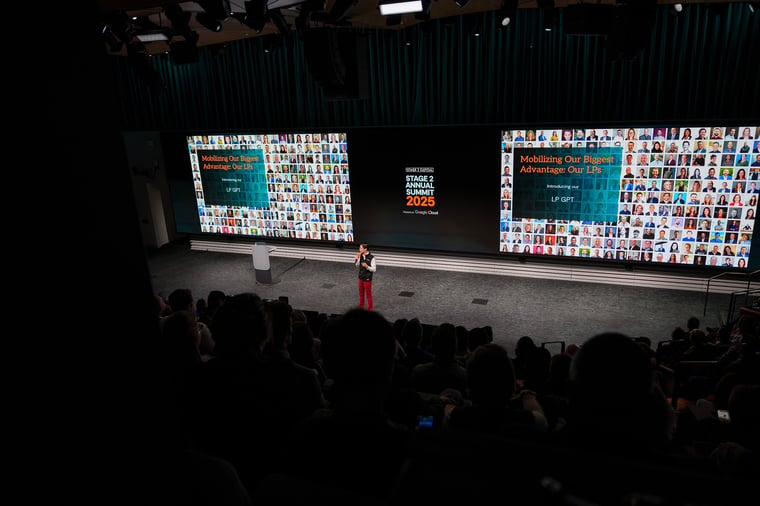
Last year, Stage 2 Capital hosted its first large-scale Founder Summit in New York City. 350+ attendees. A mix of Stage 2 LPs and founders. A full day of programming. Speakers, panels, fireside chats, sponsors, swag, and a lot of moving parts in between. We had an 86% attendance rate, which was amazing. But even with all that went right, I learned a ton along the way. (I added a few tips on how I'm using AI for the 2026 event. If you're looking for quick ways to apply AI to your next one, skip ahead to the end.)
As I kick off planning for our 2026 Annual Summit (back again in November 2026, this time in SF — stay tuned), I've been thinking a lot about what I'd tell myself if I were starting over.
1. Start with the event goal. Don't be afraid to ask "why?"
This sounds obvious, but events have a way of taking shape because someone wants to do one — and then the goal gets created after the fact.
Write it down.
Before you lock in a venue, pitch speakers, or design a single piece of promo content, align with your team on what you're actually trying to accomplish. Is it pipeline? Brand awareness? Thought leadership? Meaningful meetings? LP relationships? And how will you measure it?
Skip this step, and you'll spend months optimizing for the wrong outcome — and you'll struggle to defend your ROI when it's over.
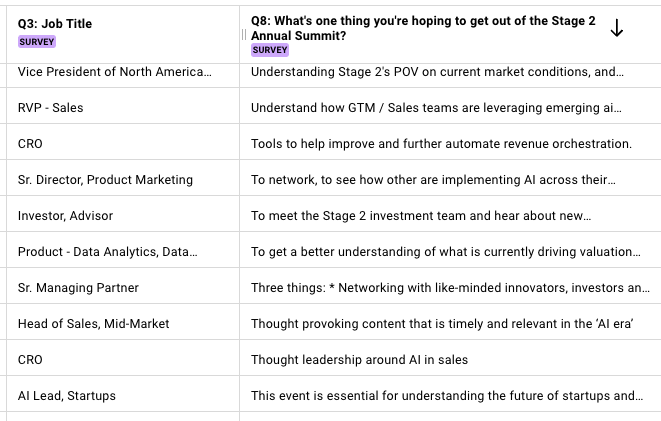
And while we had our own goals for the event, we wanted to understand what attendees hoped to get out of it. During registration, we asked a simple open-ended question: what were they most looking forward to? We used an LLM to synthesize the responses and shape the day around what people actually wanted, including prioritizing connections among attendees who flagged networking as a top priority.
2. Picking the right date and the right venue are more important than you think
Not all event spaces are created equally. So before you pick your venue, take a moment to visualize how you want your guests to move through the day. You likely won't be able to tick every box, so figure out what's more important.
At Google, the space was designed for flow. People naturally moved, gathered, and interacted. That matters more than most people realize.
Ask yourself:
- Do you want structured sessions or organic networking?
- Where will people linger?
- How will they move between moments?
You'll also want to check the calendar carefully. Are major events in your industry happening that week? Is your audience likely to be at a big conference or on a family vacation? There is nothing worse than planning your event and discovering too late that it overlaps with a can't-miss trade show your target audience will definitely be at.
3. Choose your tech stack early
Before anything else: decide how you're going to run the operation.
For us it was pretty basic:
- Google Sheets for planning
- Gatsby for registration, segmentation, and communications
- Canva
- Google Slides
- And of course, Claude and ChatGPT
That allowed us to answer quickly: Who hasn't registered? Who's attending what? Where should we focus our outreach?
Being able to segment our list and quickly pull specific groups made it easy for our team to do targeted 1:1 outreach. When someone is willing to make personal calls or send personal messages, the last thing you want is to make them dig for the list themselves.
So much has changed in just the past six months, so next time I'll go even further with AI. I've already trained Claude on our 2025 Summit and plan to use it to generate segmented communications, automate variations, and reduce manual work. The earlier you set this up, the less chaos you'll deal with later.
4. Build your promotion like a product launch
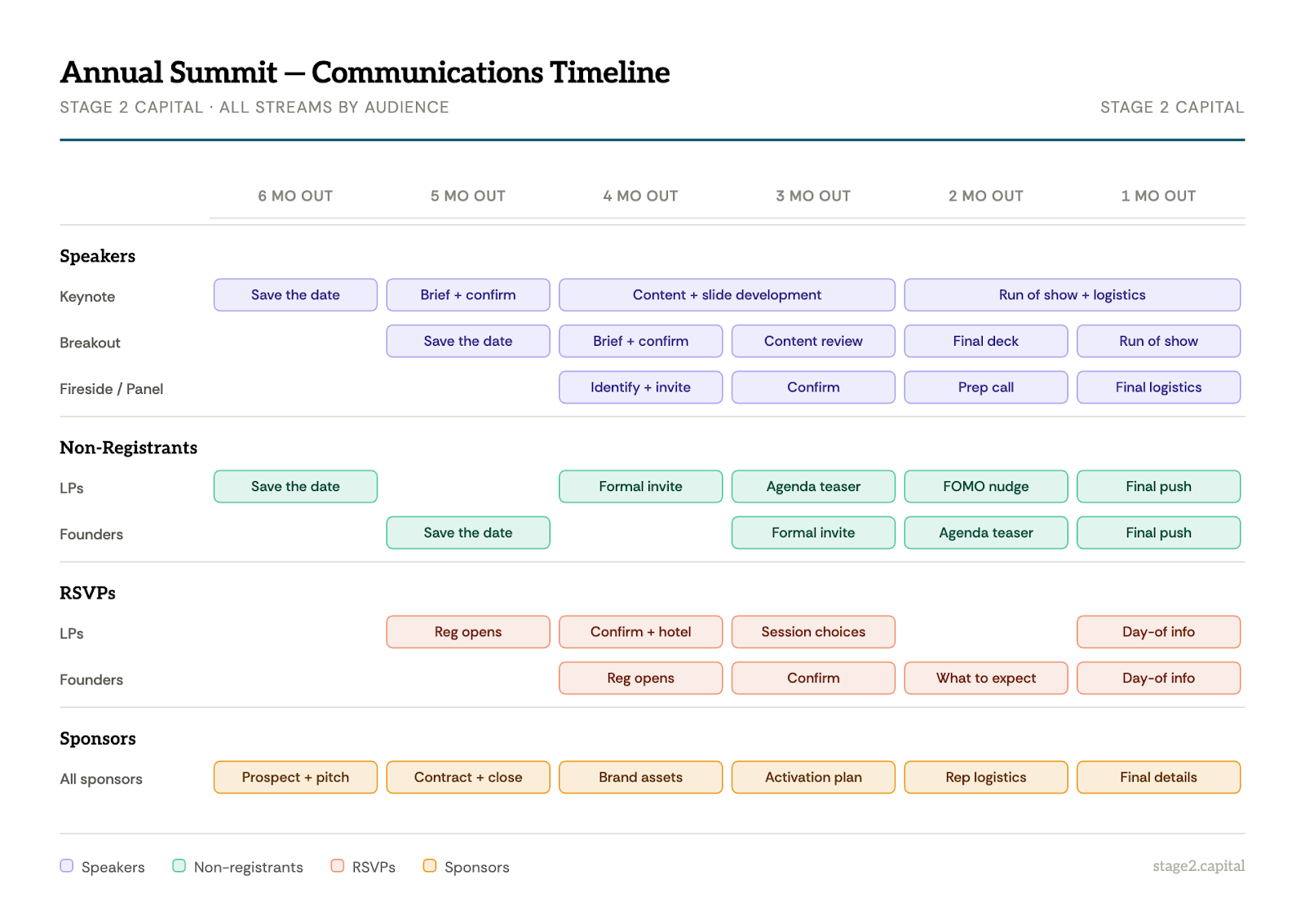
We started promoting the Summit eight months out. Getting it on people's calendars early is half the battle. Think of it like planning a wedding: send the save the date first, then layer in details as they come together.
Think in phases:
- Save the date — early, broad, just get it on the calendar
- Speaker announcements — each one is a new reason to register
- Program details — sessions, interactive elements, what the day looks like
- Attendance momentum — social proof and final push
But here's the nuance most teams miss: people have different reasons for attending. Some want content. Some want access. Some want relationships. Some want the spotlight. All of these are great reasons to attend an event — just be sure to segment your messaging accordingly.
And one more thing I'd emphasize more next time: people don't just hear about your event from you. They hear about it from speakers, attendees, partners, vendors, and your extended network. Your job is to create chatter. Give people reasons to talk about it:
- Announce speakers in ways that they'll be proud to share
- Arm partners with content (LinkedIn posts, graphics)
- Make it easy (and natural) for attendees to post
Think about your audience's sphere of influence. How do you get people talking about the event before it happens, during it, and after? We considered incentivizing social posts and decided against it because it felt contrived. Instead, we focused on creating a great experience. The result: people genuinely wanted to share it. We saw a flood of LinkedIn posts from attendees.
5. The one-to-one outreach is what actually fills the room
Broadcast gets attention, but personal outreach gets attendance.
We assigned relationship owners to key attendees to ensure they had a real, human touchpoint. Not: "Here's the event." But: "I want you there."
We also made introductions before the event, connecting people in advance so they arrived with momentum. This is one of the highest ROI things you can do.
And I'd go even further next time: map "who should meet who" earlier, facilitate more pre-event connections, and turn the event into a continuation — not a starting point or a one-off.
6. Run your day-of team like a pit crew
One of the things I'm most proud of operationally: the day of the Summit was smooth. That didn't happen by accident.
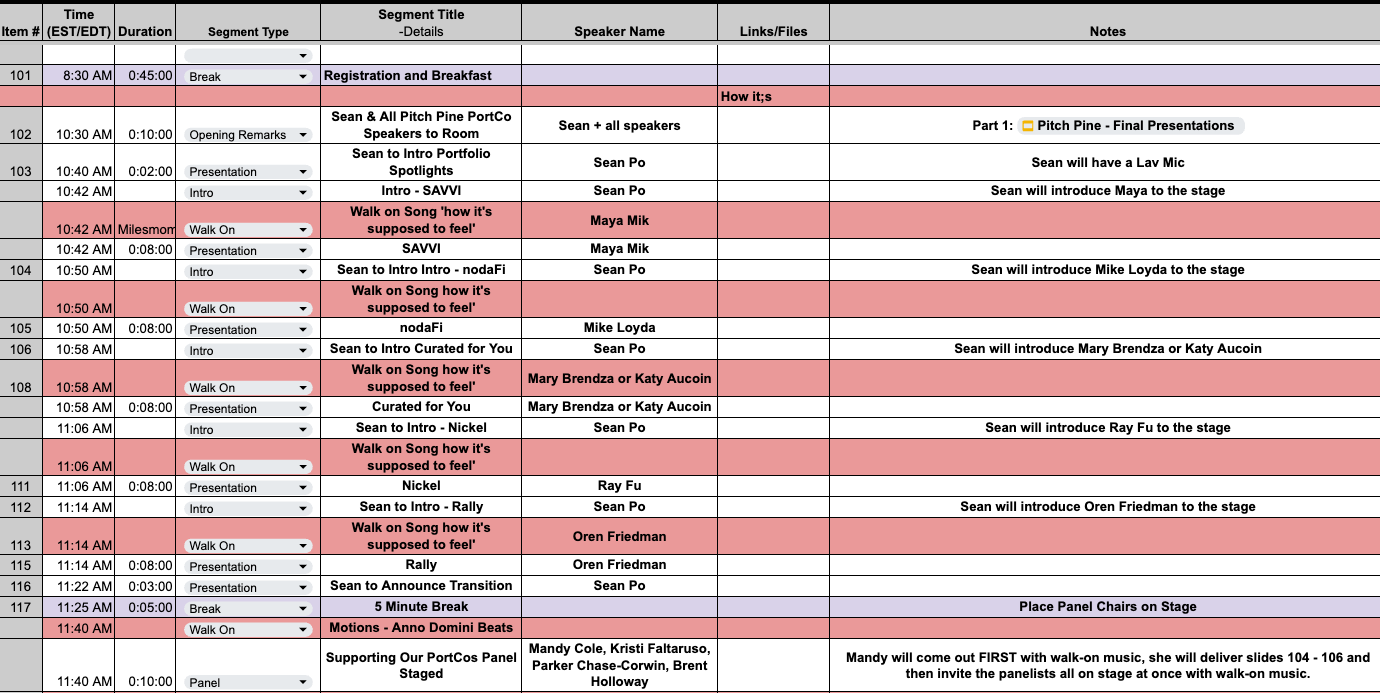
We built a master run-of-show spreadsheet broken out by hour. Every team member had their own column — exactly where they needed to be and what they needed to be doing, from greeting at the door to running a session to staffing the networking break. Each person had a personal call sheet for the day. When everyone knows their lane, things don't fall through the cracks.
The day prior, the Stage 2 team met at the venue for a detailed walk-through of the space, the session rooms, and the reception areas. Everyone was able to experience how long it took to get from the main stage to the different breakout rooms.
We also used voice announcements for transitions, managed pacing tightly, and adjusted live when sessions ran long.
Having your day end at 5pm with a networking hour ahead is a gift. Having it drag past 5pm with no end in sight is a buzzkill. Track your pacing live and be willing to adjust. Attendees shouldn't have to think. If they're wondering where to go, you've already lost momentum.
7. Think of sponsors as experience partners, not logos
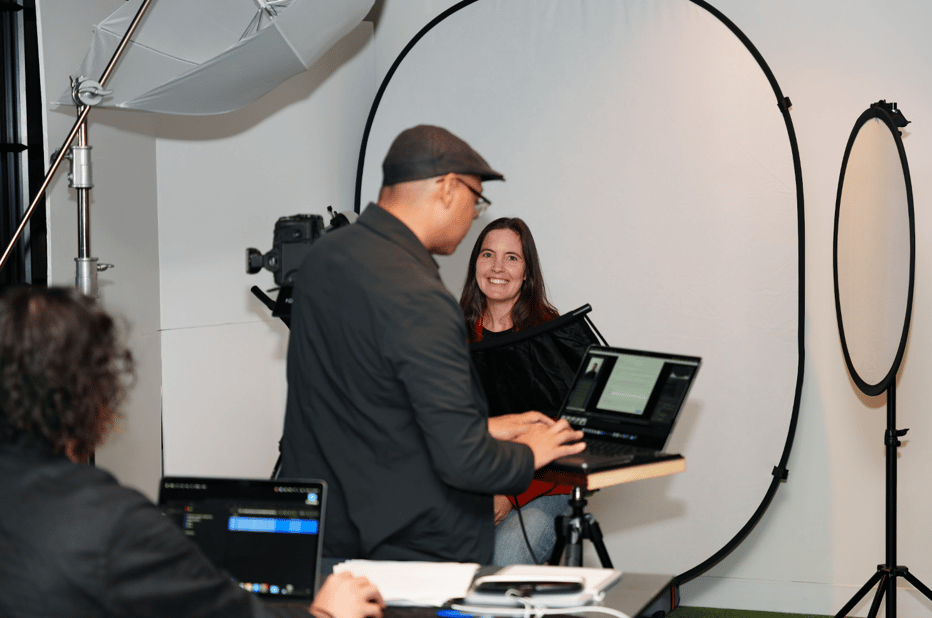
The best sponsor integrations don't feel like sponsorships. Ask yourself: how can this partner make the day better for attendees?
For example:
- HubSpot did a live podcast recording as part of our programming — not a standard fireside chat, but a real show recording with our audience in the room
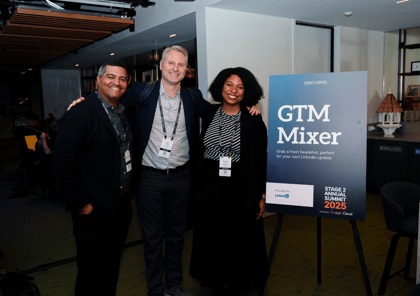
- LinkedIn provided professional headshots on-site — attendees left with something tangible and useful
- Sendoso handled personalized swag delivery for our LPs
Sponsors got access to our audience. Attendees got real value. It didn't feel sponsor-y. That's the goal.
8. Rethink swag for a traveling audience
We knew most of our attendees were flying in, and many had early flights out the next morning. So instead of loading people up with bags they'd have to haul through the airport, we placed QR codes at the event. Attendees scanned them, entered their addresses, and their swag kit arrived at their door by the time they got home — complete with a handwritten note.
For a senior audience, thoughtfulness matters more than stuff. This innovative swag experience was powered by Sendoso, one of our portfolio companies.
9. Plan your content capture before the event, not after
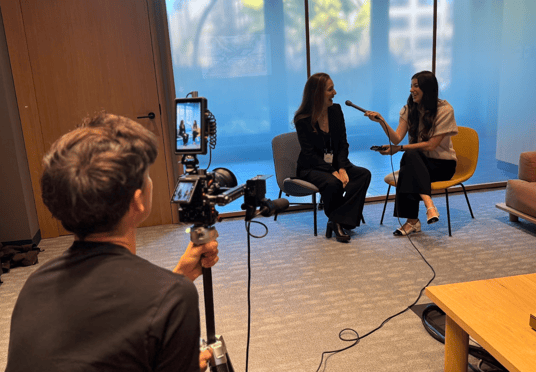
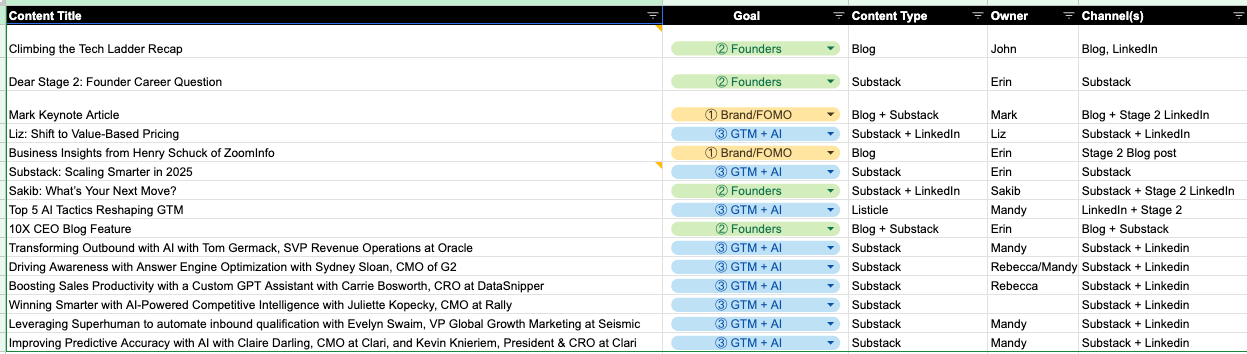
If I could redo one thing, it's this. We captured content — but we didn't fully plan how to use it in advance. There was just too much going on to get ahead of it. This year I'll be leaning into AI to make this happen.
I recommend mapping out in advance:
- Clips by session
- Speaker soundbites
- Founder insights
- Social moments
- Post-event articles
- A full content calendar tied to goals
Because the event isn't the end — it's the start of a content engine. The goal isn't just to document the event; it's to extend its impact for months.
10. Connect people before they arrive
Pre-event introductions change everything. A room of strangers becomes a room of ongoing conversations. Even a few thoughtful connections in advance can dramatically improve the experience.
11. Don't forget internal communication
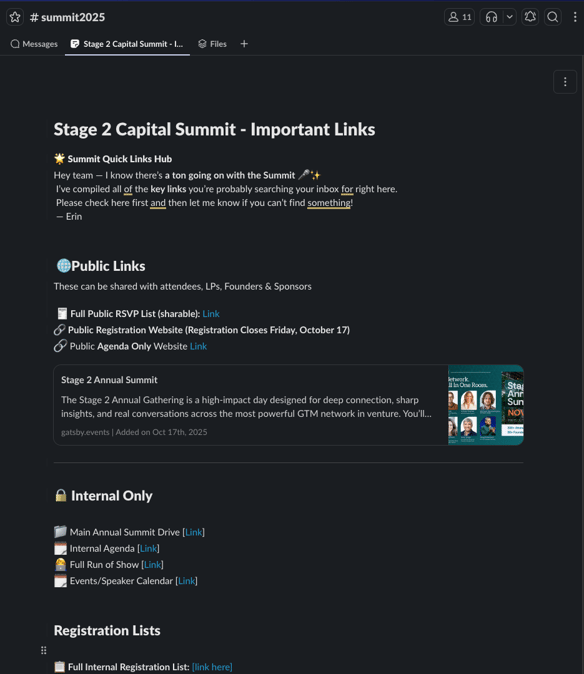
This one is easy to overlook — and critical. We created a dedicated Slack hub with all key links, schedules, responsibilities, and real-time updates. It kept everyone aligned and reduced friction throughout the day.
Next time, I'd go even further: more structured updates leading up to the event, clearer ownership visibility, and tighter coordination across internal stakeholders. Your internal team is part of the experience. Treat them that way.
12. How I'm planning to use AI this year
I mentioned earlier that I've trained Claude on our 2025 Summit. But I want to get specific, because the three things I'm doing this year go further than I expected to be possible even six months ago.
Training Claude on everything from last year
I've created a Claude Project trained on everything from our 2025 Summit: session content, transcripts, tracking spreadsheets, timelines, emails, Slack messages, satisfaction surveys, LinkedIn posts — all of it. Now it's my institutional memory. I can ask things like how do our registration numbers compare to last year at this point? or what topics generated the most energy, and what should we change? Instead of hunting through folders, I get a synthesized answer in seconds. I can also use it as a strategic thought partner to test new ideas or generate new ones.
Turning inbox chaos into an automated tracker
Big events generate a lot of back-and-forth. Last year, staying on top of it was manual: have a meeting, work through the tracker, ask everyone to update their rows. This year, I've built agents that scan my inbox automatically, pick up anything from specific contacts or mentioning the Summit, and push that data into a spreadsheet or tracker like Monday.com — without me touching it. You can extend the same workflow to Slack, call transcripts, wherever your conversations live.
Automate communications and increase personalization
We know that people attend for different reasons, and our communications should match those reasons. By training Claude on different attendee personas, I can have it write messaging that actually speaks to each one — rather than sending the same email to everyone and hoping it lands.
Building a sponsor experience site
This year I vibe-coded a simple website: highlights from last year, key metrics, what 2026 will look like. A living document I update once and share everywhere.
The big takeaway
As I kick off planning for our 2026 Annual Summit in November and start investigating San Francisco venues, here's what I'll be reminding myself:
- Get clear on your goals.
- Build your promotion intentionally.
- Set up your tools before the chaos starts.
- Run the day like a machine.
- And then get out of the way and let the people in the room do what they came to do.